Advanced-Stage Emphysema
What Is Advanced-Stage Emphysema? Hyperinflation, CT and Pulmonary Function, Endobronchial Valves, Lung Volume Reduction Surgery, and Transplantation Options.
What Is Advanced-Stage Emphysema? Treatment and Volume Reduction Methods
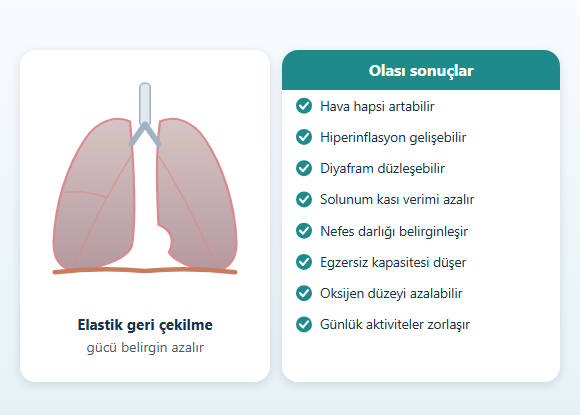
Advanced-stage emphysema is a chronic lung disease in which structural damage to the alveolar walls has become pronounced, the elastic recoil of the lung tissue is significantly reduced, and air trapping and hyperinflation can seriously affect breathing mechanics.
As emphysema progresses, it is not only the lung surface available for gas exchange that decreases. The inability of the lungs to empty adequately during exhalation can also become a significant problem.
As a result:
The anatomical features of the disease are evaluated together with the person's pulmonary function, degree of hyperinflation, gas exchange, exercise capacity, symptoms, and overall health. This detailed evaluation is especially important for patients being considered for advanced treatments such as endobronchial valves, lung volume reduction surgery, or lung transplantation.
- Air trapping in the lungs may increase
- Hyperinflation may develop
- The diaphragm may flatten
- The mechanical efficiency of the respiratory muscles may decrease
- Shortness of breath may become more pronounced
- Exercise capacity may decline
- Oxygen levels may drop
- Daily activities may become increasingly difficult
The anatomical features of the disease are evaluated together with the person's pulmonary function, degree of hyperinflation, gas exchange, exercise capacity, symptoms, and overall health. This detailed evaluation is especially important for patients being considered for advanced treatments such as endobronchial valves, lung volume reduction surgery, or lung transplantation.
What Does Advanced-Stage Emphysema Mean?
Emphysema is characterized by damage to the alveolar walls and the elastic tissue that supports them.
As the disease progresses, small air spaces can merge, forming larger areas that are less efficient for gas exchange.
The reduced elastic recoil of the lung can cause the small airways to close earlier during exhalation.
In this situation:
Two people with a similar amount of emphysema on CT may differ in shortness of breath, exercise capacity, and gas exchange.
In this situation:
- Air cannot be exhaled
- Air builds up in the lungs
- Residual volume may increase
- The lungs may become overinflated
- The respiratory muscles may have to work harder
Two people with a similar amount of emphysema on CT may differ in shortness of breath, exercise capacity, and gas exchange.
Are Advanced-Stage Emphysema and Advanced-Stage COPD the Same Thing?
No.
COPD is a broader clinical disease framework characterized by persistent airflow limitation.
Emphysema, on the other hand, refers to structural damage to the lung tissue.
In patients with advanced COPD, the following may be present in varying proportions:
In advanced emphysema, structural damage to the lung tissue, loss of elasticity, air trapping, and hyperinflation are the predominant features. This distinction is important in determining advanced treatment options.
In patients with advanced COPD, the following may be present in varying proportions:
- Emphysema
- Small airway disease
- Chronic bronchitis
In advanced emphysema, structural damage to the lung tissue, loss of elasticity, air trapping, and hyperinflation are the predominant features. This distinction is important in determining advanced treatment options.
What Are the Symptoms of Advanced-Stage Emphysema?
One of the most prominent complaints is progressive shortness of breath.
Symptoms may include:
If chronic bronchitis or other airway diseases are also present, cough and sputum may occur as well.
Symptoms may include:
- Shortness of breath over short distances
- Marked difficulty climbing stairs
- Frequent need to rest during daily activities
- Severely reduced exercise capacity
- A feeling of being unable to fully exhale
- Prolonged exhalation
- A feeling of excessive fullness in the chest
- Fatigue
- Reduced physical endurance
- Weight loss
- Muscle loss
- Low oxygen levels in advanced disease
If chronic bronchitis or other airway diseases are also present, cough and sputum may occur as well.
Why Does Shortness of Breath Increase in Advanced Emphysema?
In healthy lungs, elastic tissue helps the lungs shrink back after each breath in.
This elastic recoil makes it easier to push air out during exhalation.
In emphysema, as elastic support is lost, the small airways can narrow or close more easily during exhalation.
Air begins to become trapped in the lungs.
When air trapping increases:
When air trapping increases:
- Lung volume increases
- The diaphragm is pushed downward
- The diaphragm flattens
- The working conditions of the respiratory muscles deteriorate
- Each breath requires more energy
Why Is Hyperinflation Important?
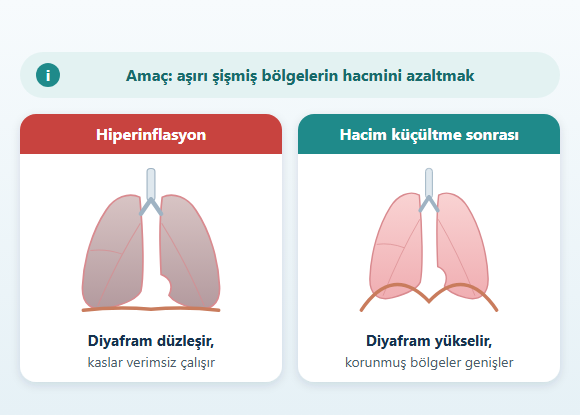
In the treatment of advanced emphysema, the degree of hyperinflation matters, not just the amount of damage to the lung tissue.
This is because the main goal of some advanced treatments is not to rebuild damaged alveoli, but to reduce the volume of overinflated areas of the lung.
In this way:
In this way:
- The diaphragm may return to a more favorable position
- Better-preserved areas of the lung may expand
- The respiratory muscles may work more efficiently
- Air trapping may decrease
- Exercise capacity may increase
- Shortness of breath may decrease
Does Advanced Emphysema Affect Oxygen Levels?
It can.
Loss of the alveolar walls reduces the surface area available for gas exchange.
Low oxygen levels may occur:
Not every patient with advanced emphysema needs to use oxygen. Oxygen therapy is evaluated based on objective measurements.
Low oxygen levels may occur:
- During exercise
- During sleep
- During exacerbations
- At rest
Not every patient with advanced emphysema needs to use oxygen. Oxygen therapy is evaluated based on objective measurements.
Weight and Muscle Loss in Advanced Emphysema
In advanced disease, some people may develop significant weight and muscle loss.
Contributing factors may include:
Muscle loss can further reduce physical capacity. Nutritional and muscle status may also be important when evaluating patients for advanced surgical or bronchoscopic procedures.
Contributing factors may include:
- Increased energy expenditure for breathing
- Reduced appetite
- Shortness of breath while eating
- Reduced physical activity
- Recurrent exacerbations
- Systemic effects of chronic disease
Muscle loss can further reduce physical capacity. Nutritional and muscle status may also be important when evaluating patients for advanced surgical or bronchoscopic procedures.
How Is Advanced-Stage Emphysema Evaluated?
Evaluating advanced emphysema requires anatomical and physiological assessments to be performed together.
The evaluation may use:
When advanced treatments are being considered, each of these tests answers a different question.
The evaluation may use:
- Spirometry
- Lung volumes
- DLCO
- Oxygen measurement
- Arterial blood gas
- Computed tomography
- Quantitative CT analysis
- Exercise tests
- Six-minute walk test
- Cardiac evaluation
When advanced treatments are being considered, each of these tests answers a different question.
What Does Spirometry Show?
Spirometry assesses airflow limitation.
The key measurements are:
In advanced emphysema, FEV1 may be significantly reduced. However, FEV1 alone does not determine the extent of emphysema or suitability for advanced treatments.
The key measurements are:
- FEV1
- FVC
- FEV1/FVC
In advanced emphysema, FEV1 may be significantly reduced. However, FEV1 alone does not determine the extent of emphysema or suitability for advanced treatments.
Why Are Lung Volumes Important?
Lung volumes provide information about air trapping and hyperinflation.
In particular, the following may be assessed:
In the treatment of advanced emphysema, how much air is trapped in the lungs is just as important as how much airflow limitation is present.
In particular, the following may be assessed:
- Residual volume
- Total lung capacity
- Functional residual capacity
In the treatment of advanced emphysema, how much air is trapped in the lungs is just as important as how much airflow limitation is present.
Why Is DLCO Important in Advanced Emphysema?
DLCO assesses the lungs' capacity to transfer gases from the alveoli into the blood.
As emphysema progresses and alveolar surface is lost, DLCO may decrease.
DLCO can provide information about:
However, DLCO alone does not determine the choice of treatment.
DLCO can provide information about:
- The state of gas exchange
- Physiological reserve
- The tendency for oxygen levels to drop during exercise
- The risk of certain surgical procedures
However, DLCO alone does not determine the choice of treatment.
Why Is Computed Tomography So Important?
In the evaluation of advanced emphysema, computed tomography is not used only to support the diagnosis.
CT can be used to assess:
Especially when bronchoscopic or surgical volume reduction is being planned, a detailed CT evaluation is one of the key elements of patient selection.
CT can be used to assess:
- The extent of emphysema
- Its distribution within the lungs
- Which lobes are more affected
- Better-preserved areas
- Homogeneous or heterogeneous distribution
- Bullae
- Fissure anatomy
- Bronchiectasis
- Lung nodules
- Other lung diseases
Especially when bronchoscopic or surgical volume reduction is being planned, a detailed CT evaluation is one of the key elements of patient selection.
What Is Quantitative CT Analysis?
Computer-assisted quantitative CT analysis may be used in selected patients with advanced emphysema.
This analysis can help assess:
Quantitative CT results alone do not constitute a treatment decision. The results are evaluated together with pulmonary function, hyperinflation, symptoms, and exercise capacity.
This analysis can help assess:
- The amount of emphysema in each lobe
- The more severely damaged lobes
- Better-preserved areas
- The potential target lobe
- Fissure integrity
Quantitative CT results alone do not constitute a treatment decision. The results are evaluated together with pulmonary function, hyperinflation, symptoms, and exercise capacity.
What Are Homogeneous and Heterogeneous Emphysema?
In heterogeneous emphysema, some areas of the lung are markedly more damaged than others.
In homogeneous emphysema, the damage is distributed more evenly throughout the lung.
This distinction is important in planning advanced treatment.
Heterogeneous emphysema with a clearly damaged target area may be advantageous for certain volume reduction methods.
However, selected patients with homogeneous emphysema may also be evaluated for certain advanced treatments.
Bullae in Advanced Emphysema
Emphysema can lead to the formation of large air-filled spaces.
These are called bullae.
Large bullae can:
- Compress better-functioning lung tissue
- Take up significant space in the chest cavity
- Disrupt breathing mechanics
- Contribute to shortness of breath
- Be associated with pneumothorax
- Become infected
What Is a Giant Bulla?
Large air spaces that occupy a significant portion of the chest cavity may be defined as giant bullae.
The treatment evaluation takes into account:
The treatment evaluation takes into account:
- The size of the bulla
- Its location
- The pressure it exerts on the surrounding lung
- The quality of the remaining lung tissue
- The patient's symptoms
- History of pneumothorax
- History of infection
What Is Bullectomy?
Bullectomy is the surgical removal of large, nonfunctional bullae.
A surgical evaluation may be performed especially if a large bulla is compressing the surrounding, better-functioning lung tissue.
The goal is for the compressed but potentially functional lung tissue to re-expand after the bulla is removed.
Bullectomy is not the same procedure as lung volume reduction surgery, which is performed for diffuse emphysema.
How Is Advanced-Stage Emphysema Treated?
Treatment is planned according to the characteristics of each person's disease.
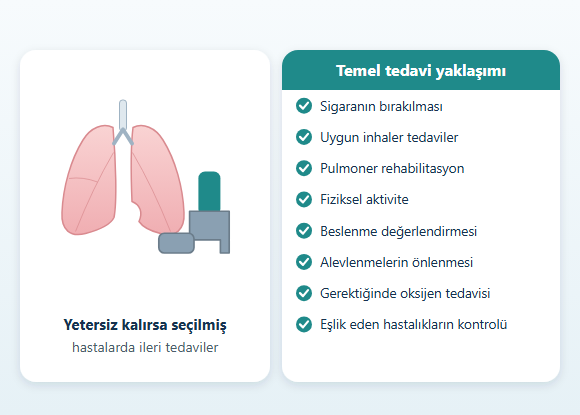
The core treatment approach may consist of steps such as:
Advanced treatments may be considered in selected patients who remain severely symptomatic despite standard treatment.
The core treatment approach may consist of steps such as:
- Quitting smoking
- Appropriate inhaler therapies
- Pulmonary rehabilitation
- Physical activity
- Nutritional assessment
- Prevention of exacerbations
- Oxygen therapy when needed
- Management of coexisting conditions
Advanced treatments may be considered in selected patients who remain severely symptomatic despite standard treatment.
Why Is Pulmonary Rehabilitation Important?
Pulmonary rehabilitation is one of the key components of advanced emphysema treatment. The program may include:- Endurance exercises
- Muscle strengthening
- Breathing techniques
- Physical activity training
- Nutritional assessment
- Disease education
Oxygen Therapy in Advanced Emphysema
Not every patient with advanced emphysema needs long-term oxygen therapy. The need for oxygen is evaluated based on objective measurements taken:- At rest
- During exercise
- During sleep
What Is Lung Volume Reduction Treatment?
In advanced emphysema, some areas of the lung may be severely damaged and overinflated. These areas can take up a large amount of space in the chest cavity while contributing little to gas exchange. The goal of volume reduction treatment is to reduce the volume these areas occupy. In this way, in selected patients:- Air trapping can be reduced
- The mechanical position of the diaphragm can be improved
- Better-functioning lung tissue can expand
- The efficiency of the respiratory muscles can be increased
- Shortness of breath can be reduced
- Exercise capacity can be increased
What Is Lung Volume Reduction Surgery?
In lung volume reduction surgery, the most severely damaged areas of the lung that contribute most to hyperinflation are surgically removed. The goal is not to preserve as much lung tissue as possible. By removing areas that have very little function but take up excess volume in the chest, the aim is to allow the remaining lung to work under more favorable mechanical conditions. In selected patients:- Hyperinflation may decrease
- Diaphragm function may improve
- Shortness of breath may decrease
- Exercise capacity may increase
- Quality of life may improve
Who Is a Candidate for Lung Volume Reduction Surgery?
Patient selection takes the following into account together:- Severity of emphysema
- Distribution of emphysema
- Whether it is heterogeneous or homogeneous
- FEV1
- Residual volume
- Total lung capacity
- DLCO
- Exercise capacity
- Results of pulmonary rehabilitation
- Smoking
- Heart disease
- Pulmonary hypertension
- Nutritional status
- Overall surgical risk
What Are the Risks of Lung Volume Reduction Surgery?
Possible complications include:- Prolonged air leak
- Pneumothorax
- Pneumonia
- Bleeding
- Respiratory failure
- Heart rhythm disorders
- Cardiovascular complications
- Blood clots
- Need for intensive care
- Reoperation
- Death
What Is Bronchoscopic Lung Volume Reduction?
Bronchoscopic lung volume reduction refers to methods that aim to reduce the volume of selected areas of the lung using a bronchoscope, without surgically opening the chest. Among these methods, the strongest scientific evidence exists for one-way endobronchial valves. Other methods that have been studied include:- Bronchoscopic coil systems
- Thermal vapor ablation
- Biological or chemical methods
- New airway implants
What Is an Endobronchial Valve?
An endobronchial valve is a small one-way device placed via bronchoscope in the airways leading to a selected target lobe. The valve:- Allows air to leave the target lobe
- Reduces or prevents new air from entering
- Aims to reduce the volume of the target lobe
Who Is a Candidate for Endobronchial Valves?
Patient selection may take into account:- Advanced emphysema
- Marked hyperinflation
- Persistent symptoms despite optimal treatment
- A suitable target lobe
- Distribution of emphysema between the lobes
- Fissure integrity
- Collateral ventilation
- Pulmonary function
- Exercise capacity
- Smoking
- Infection
- Bronchiectasis
- Amount of sputum
- Heart disease
- Pulmonary hypertension
What Is Collateral Ventilation?
Collateral ventilation is the passage of air from neighboring lung lobes into the target lobe through alternative connections outside the normal bronchial pathways. Even if an endobronchial valve blocks the airways leading to the target lobe, air can continue to reach the target lobe if significant collateral ventilation is present. In this case, the target lobe may not shrink sufficiently. For this reason, the absence of significant collateral ventilation is one of the important criteria for the success of valve treatment.Why Is Fissure Integrity Important?
The anatomical structures that separate the lobes of the lung from one another are called fissures. Complete fissures can limit the passage of air between lobes. When fissures are incomplete, the likelihood of collateral ventilation may increase. For this reason, fissure integrity may be assessed on CT when planning endobronchial valve treatment. In patients who require it, collateral ventilation can also be measured separately during bronchoscopy.What Happens After Endobronchial Valve Placement?
If the valve successfully isolates the target lobe:- Air in the target area can escape
- New air entry may decrease
- The target lobe may shrink
- Partial or complete lobar atelectasis may develop
- Neighboring areas of the lung may expand
- The mechanical position of the diaphragm may improve
What Are the Potential Benefits of Endobronchial Valves?
In appropriately selected patients, the following may be seen:- Reduced hyperinflation
- Lower residual volume
- Improvement in FEV1
- Less shortness of breath
- Increased walking capacity
- Increased exercise tolerance
- Improved quality of life
What Are the Risks of Endobronchial Valves?
One of the most important early complications is pneumothorax. As the target lobe shrinks, the expansion of other areas of the lung can cause an air leak and pneumothorax in some patients. Other possible complications include:- COPD exacerbation
- Pneumonia
- Bleeding
- Increased sputum
- Valve migration
- Valve blockage
- Tissue growth around the valve
- Insufficient shrinkage of the target lobe
- Respiratory failure
- Need for additional bronchoscopy
- Need to remove the valves
Can Endobronchial Valves Be Removed?
When necessary, endobronchial valves can usually be removed bronchoscopically. Reasons for removal may include:- Lack of clinical benefit
- Infection
- Valve migration
- Airway reaction
- Other complications
Endobronchial Valves or Lung Volume Reduction Surgery?
The main goal of both treatments is to reduce hyperinflation, but they achieve it in different ways. Endobronchial valves:- Are placed bronchoscopically
- Do not remove lung tissue
- Require a suitable target lobe
- Are affected by collateral ventilation
- Can be removed if necessary
- Carry a significant risk of pneumothorax
- Surgically removes damaged lung tissue
- Is not affected by collateral ventilation as much as valves are
- Involves a greater surgical burden
- May require a longer recovery period
Other Bronchoscopic Treatments
In addition to endobronchial valves, other bronchoscopic volume reduction methods have also been studied. These include:- Coil systems
- Thermal vapor ablation
- Biological volume reduction
- Chemical methods
- Various airway implants
Is the "COPD Balloon" a Treatment for Advanced Emphysema?
The bronchoscopic method known as the "COPD balloon" does not have the same mechanism as lung volume reduction methods. This approach is mainly directed at the airways. The COPD balloon:- Does not remove damaged emphysematous tissue
- Does not rebuild alveoli
- Does not shrink the target lobe the way an endobronchial valve does
- Is not a substitute for lung volume reduction surgery
Lung Transplantation in Advanced Emphysema
Lung transplantation may be considered in selected patients with very advanced, irreversible emphysema. Situations that may be important in the evaluation generally include:- Persistent severe symptoms despite optimal medical treatment
- Severe loss of function despite pulmonary rehabilitation
- No suitable or adequate volume reduction option
- Advanced respiratory failure
- Significant oxygen requirement
- Elevated carbon dioxide levels
- Poor disease-related prognosis
Risk of Pneumothorax in Advanced Emphysema
The risk of pneumothorax may be increased in some patients, especially those with bullous or paraseptal emphysema. Pneumothorax is the partial or complete collapse of the lung caused by air entering the pleural space. Symptoms may include:- Sudden-onset, one-sided chest pain
- Sudden shortness of breath
- Rapid breathing
- A drop in oxygen levels
How Is Advanced Emphysema Monitored?
The follow-up plan may vary depending on the severity of the disease and the treatments received. At follow-up visits, the following may be assessed:- Shortness of breath
- Exercise capacity
- Exacerbations
- Spirometry
- Lung volumes
- Oxygen levels
- Weight and muscle status
- Smoking
- Inhaler therapy
- Coexisting conditions
- Imaging when needed
When Is Emergency Evaluation Needed in Advanced Emphysema?
Emergency medical evaluation may be needed in the following situations:- Sudden, severe shortness of breath
- New one-sided chest pain
- Coughing up blood
- Significantly low oxygen levels
- Bluish discoloration of the lips or face
- Confusion
- Excessive sleepiness
- Worsening breathing together with high fever
- Sudden palpitations or fainting
- Sudden shortness of breath together with swelling in one leg
Frequently Asked Questions About Advanced-Stage Emphysema
Can advanced-stage emphysema be cured?
Damaged alveolar walls are not expected to be rebuilt with standard treatments. The goals of treatment are to reduce ongoing damage, control shortness of breath, support breathing mechanics, and, in suitable patients, reduce hyperinflation with advanced treatments.
Does advanced emphysema always require oxygen?
No. Oxygen therapy is not started automatically just because emphysema appears advanced on imaging or breathing tests. Objective oxygen measurements are taken into account.
Can every patient with advanced emphysema receive endobronchial valves?
No. Valve treatment requires features such as a suitable target lobe, sufficient hyperinflation, and suitable fissure anatomy. Collateral ventilation also plays an important role in patient selection.
Do endobronchial valves cure emphysema?
The valve does not rebuild damaged alveoli. The aim is to reduce the volume of a selected overinflated area of the lung so that the remaining lung and the diaphragm can work under more favorable mechanical conditions.
Can lung volume reduction surgery be performed on every patient with advanced emphysema?
No. Many factors are evaluated together, such as the distribution of emphysema, hyperinflation, FEV1, DLCO, exercise capacity, and overall surgical risk.
Are bullectomy and lung volume reduction surgery the same?
No. Bullectomy is aimed at removing distinct large bullae. Lung volume reduction surgery, by contrast, targets the most severely damaged areas within diffuse emphysema that contribute to hyperinflation.
Can lung transplantation be performed for advanced emphysema?
Transplantation may be considered in selected patients with very advanced, irreversible emphysema. Eligibility is determined not only by lung function but also by the person's overall health and many other criteria.
How is the most suitable treatment decided?
The decision is not based solely on whether the emphysema is advanced. The distribution on CT, hyperinflation, fissure anatomy, collateral ventilation, pulmonary function, exercise capacity, symptoms, and coexisting conditions are all evaluated together.
The surgical approach is determined by the anatomical features of the tumor and the extent of the planned operation.
Conclusion
Advanced-stage emphysema does not simply mean an increase in structural damage to the lung tissue. One of the most important consequences of the disease is air trapping and hyperinflation. In advanced disease:- Elastic recoil may decrease
- Air may become trapped in the lungs
- Lung volume may increase
- The diaphragm may flatten
- The mechanical efficiency of the respiratory muscles may decrease
- Shortness of breath may increase
- Exercise capacity may decline
- Spirometry
- Lung volumes
- DLCO
- Oxygen and, when needed, arterial blood gas
- Exercise capacity
- Detailed computed tomography
- Quantitative CT analysis when needed
- Bullectomy
- Lung volume reduction surgery
- Bronchoscopic lung volume reduction with endobronchial valves
- Other selected bronchoscopic methods
- Lung transplantation
Disclaimer The information on this page is provided for general informational purposes only and does not replace a medical examination, diagnosis, or individualized treatment plan. The evaluation and treatment of advanced-stage emphysema are determined individually based on the extent and distribution of lung damage, the degree of hyperinflation, pulmonary function, gas exchange, exercise capacity, previous treatments, and the person's overall health.