Compensatory Sweating
Why does compensatory sweating occur after ETS? Information on affected areas, severity, risk factors, and current treatment approaches.
Compensatory Sweating
Compensatory sweating is sweating that newly appears or markedly increases in areas of the body that previously sweated less, following a surgical procedure on the sympathetic nervous system.
It is most commonly discussed as one of the long-term effects that can occur after endoscopic thoracic sympathetic surgery, commonly known as ETS.
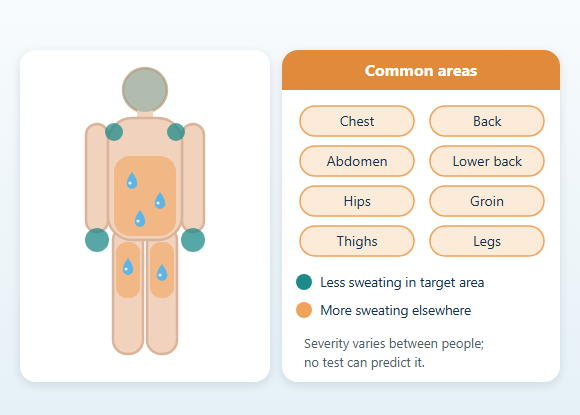
During sympathetic surgery, conduction along certain nerve pathways involved in sweating is interrupted. After surgery, sweating in the targeted areas, such as the hands, underarms, or face, may decrease markedly. In contrast, sweating may increase in other areas of the body.
Areas where compensatory sweating commonly occurs include:
- Chest
- Back
- Abdomen
- Lower back and waist
- Buttocks
- Groin
- Thighs
- Legs
What Is Compensatory Sweating?
Compensatory sweating, or compensatory hyperhidrosis, refers to the change in the body's sweating pattern that occurs after sympathetic nerve surgery.
Before surgery, excessive sweating may mainly affect the hands, underarms, face, or scalp.
After surgery, sweating in the targeted area decreases, while sweat production may increase in areas that previously sweated normally or only a little.
The sweating is usually on both sides of the body and can affect a large body surface.
In some people only the lower back or back is affected, while in others the sweating may spread over a large part of the trunk and lower body.
Its severity can range from mild dampness to repeated soaking of underwear and outer clothing.
How Common Is Compensatory Sweating After ETS?
Reported rates of compensatory sweating vary considerably between studies.
The main reasons for this include:
In a systematic review and meta-analysis published in 2025 that included 3,117 patients, the overall rate of compensatory hyperhidrosis was calculated at approximately 62%. In studies that separately assessed severe compensatory hyperhidrosis, the pooled rate was approximately 23%. However, because there is marked variation between studies, these rates do not mean that every person carries the same risk. The clinically important point is that compensatory sweating is a known and relatively common effect of thoracic sympathetic surgery, but whether it will occur in a particular person, or how severe it will be, cannot be predicted with certainty before surgery.
The main reasons for this include:
- Rates of 50–75% after ETS sympathectomy versus 5% after ETS ramisectomy
- Differences in the sympathetic nerve levels treated
- Different definitions of compensatory sweating
- Differences in follow-up periods
- Climate conditions
- Patient characteristics
In a systematic review and meta-analysis published in 2025 that included 3,117 patients, the overall rate of compensatory hyperhidrosis was calculated at approximately 62%. In studies that separately assessed severe compensatory hyperhidrosis, the pooled rate was approximately 23%. However, because there is marked variation between studies, these rates do not mean that every person carries the same risk. The clinically important point is that compensatory sweating is a known and relatively common effect of thoracic sympathetic surgery, but whether it will occur in a particular person, or how severe it will be, cannot be predicted with certainty before surgery.
In Which Areas Does Compensatory Sweating Occur?
Compensatory sweating most commonly occurs on the trunk and lower body.
Areas that may be affected include:
The distribution of sweating varies from person to person. In some people sweating may be concentrated in a small, limited area, while in others it may affect a large part of the trunk and legs. Heat, humidity, physical activity, working conditions, and stress can affect the amount and distribution of sweating.
Areas that may be affected include:
- The front of the chest
- Beneath the chest
- The upper back
- The lower back
- The abdomen
- Around the waist
- The buttocks
- The groin
- The inner or back of the thighs
- The back of the knees
- The lower legs
The distribution of sweating varies from person to person. In some people sweating may be concentrated in a small, limited area, while in others it may affect a large part of the trunk and legs. Heat, humidity, physical activity, working conditions, and stress can affect the amount and distribution of sweating.
Why Does Compensatory Sweating Occur?
The exact mechanism of compensatory sweating has not been fully explained.
The sympathetic nervous system plays a role in regulating:
When part of the sympathetic nerve pathway is surgically interrupted, sweat production may decrease in the corresponding areas. In contrast, changes may occur in the sweating pattern of other areas of the body.
Proposed possible mechanisms include:
Compensatory sweating should not be explained as a simple “compensation” mechanism in which the reduced amount of sweat on the hands or face is released in the same amount from another part of the body. The physiological mechanism is more complex than that.
The sympathetic nervous system plays a role in regulating:
- Sweat production
- Blood vessel tone
- Heart rate
- Responses to heat
- Certain involuntary stress-related reactions
When part of the sympathetic nerve pathway is surgically interrupted, sweat production may decrease in the corresponding areas. In contrast, changes may occur in the sweating pattern of other areas of the body.
Proposed possible mechanisms include:
- Changes in central temperature regulation
- A change in the sweating threshold
- Differences in the activity of unaffected sympathetic pathways
- A change in the response to heat and exercise
- Reorganization of autonomic nervous system signals
Compensatory sweating should not be explained as a simple “compensation” mechanism in which the reduced amount of sweat on the hands or face is released in the same amount from another part of the body. The physiological mechanism is more complex than that.
Are Reflex Sweating and Compensatory Sweating the Same?
The term “reflex sweating” may be used in everyday language to describe the trunk sweating that occurs after sympathetic surgery.
However, in medical terminology the terms compensatory sweating or compensatory hyperhidrosis are more common.
This condition:
This condition:
- Does not result from the person's conscious behavior
- Is not under the person's control
- Is not explained by poor hygiene
- Is not merely a psychological reaction
When Does Compensatory Sweating Begin?
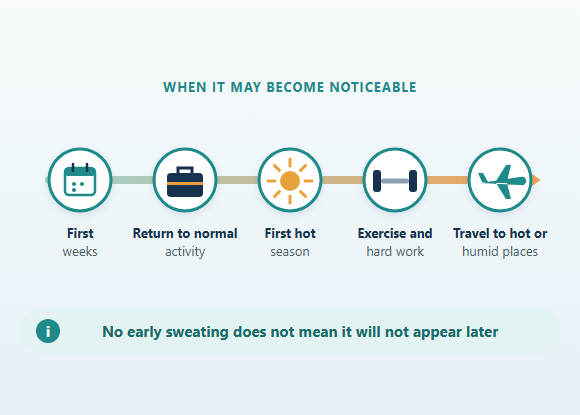
Compensatory sweating may be noticed shortly after surgery, or it may become more noticeable over weeks or months.
When the symptoms are first noticed can be influenced by climate conditions.
For example, in a person who has surgery during the winter months, new sweating may not be very noticeable at first. As the weather warms and humidity rises, the true severity of the symptoms may become more apparent.
Compensatory sweating may become more noticeable:
- In the first weeks after surgery
- When returning to normal physical activity
- During the first hot season after surgery
- During exercise
- When returning to a physically demanding work routine
- When traveling to a hotter or more humid region
Does Compensatory Sweating Go Away Over Time?
The long-term course of compensatory sweating varies from person to person.
Some people report that their symptoms become less bothersome over time, or that they adapt better to the new sweating pattern through adjustments in clothing, activities, and surroundings.
However, adapting to the condition may not mean that the amount of sweat has physiologically decreased.
In some people, compensatory sweating may continue for years.
Long-term studies have reported differing results. In some people the symptoms may be perceived as milder over time, while in others they may continue at a similar level or become more noticeable, especially during hot periods.
For this reason, it cannot be said in advance that compensatory sweating will resolve completely on its own.
How Is the Severity of Compensatory Sweating Assessed?
The severity of compensatory sweating is not assessed only by the amount of sweat produced.
Its impact on daily life is also important.
The assessment may take into account:
The assessment may take into account:
- The areas affected
- The total body area that sweats
- How often sweating episodes occur
- Its relationship to heat and physical activity
- Wetness of clothing
- The need to change clothes
- Its impact on work life
- Its impact on exercise
- Skin problems
- Avoidance of social activities
- Comparison with the hyperhidrosis present before surgery
Mild Compensatory Sweating
Sweating occurs mainly in hot weather or during physical activity.
Mild dampness of the skin or small sweat marks on clothing may be seen.
It may not require any significant change in daily life.
Moderate Compensatory Sweating
Sweating occurs more often and may cause visible wetness on clothing.
The person may need to:
Comfort at work and in social life may be affected.
The person may need to:
- Change clothes during the day
- Carry spare clothes
- Avoid certain fabrics
Comfort at work and in social life may be affected.
Severe Compensatory Sweating
Sweating may affect large areas of the body and cause clothing to become significantly soaked.
The sweating may:
The sweating may:
- Run down the trunk
- Soak underwear and outer clothing
- Create a need to change clothes repeatedly during the day
- Begin with light physical activity
- Affect work activities
- Limit exercise or social activities
Is All Sweating After ETS Compensatory Sweating?
No.
Sweating on the chest, back, abdomen, and legs in hot weather or during physical activity can be physiological (normal).
The key feature that suggests compensatory sweating is the appearance, after sympathetic surgery, of a marked new sweating pattern that was not present before.
Features that may suggest this include:
Nevertheless, not every new episode of sweating after ETS should automatically be attributed to the surgery.
Features that may suggest this include:
- Previously dry areas starting to sweat heavily after ETS
- Increased trunk sweating while the area targeted by surgery stays dry
- Sweating spreading over a much larger body area than before
- Clothing becoming noticeably wet during light activity
- A marked change in the sweating response to heat compared with before surgery
Nevertheless, not every new episode of sweating after ETS should automatically be attributed to the surgery.
Is Compensatory Sweating the Same as Recurrent Hyperhidrosis?
No.
Compensatory sweating is new or increased sweating in areas that were not the main problem before surgery.
Recurrent hyperhidrosis, on the other hand, is the return of excessive sweating in the area targeted by surgery.
For example:
For example:
- Heavy sweating developing on the back while the hands stay dry may be consistent with compensatory sweating.
- The return of severe hand sweating may suggest recurrent palmar hyperhidrosis.
- If the hands have started sweating again and new sweating has also appeared on the trunk, both conditions may be present together.
Is Compensatory Sweating the Same as Gustatory Sweating?
No.
Gustatory sweating is sweating related to eating.
It may be triggered especially by:
Gustatory sweating occurs mostly on the face, forehead, scalp, or neck. Compensatory sweating, by contrast, more often affects the trunk and lower body. Both compensatory and gustatory sweating may occur in the same person after sympathetic surgery.
It may be triggered especially by:
- Hot or spicy foods
- Hot meals
- Sour foods
- Strongly flavored foods
Gustatory sweating occurs mostly on the face, forehead, scalp, or neck. Compensatory sweating, by contrast, more often affects the trunk and lower body. Both compensatory and gustatory sweating may occur in the same person after sympathetic surgery.
Who May Be at Higher Risk of Compensatory Sweating?
It is not possible to predict with certainty whether compensatory sweating will develop in a particular person.
Research has examined various factors, such as:
In a meta-analysis published in 2025, older age, higher body mass index, and a history of smoking were found to be associated with compensatory hyperhidrosis. In the same analysis, a high body mass index was also associated with severe compensatory hyperhidrosis. However, these associations are not sufficient to predict individual risk with certainty. Severe compensatory sweating can occur in a person with no notable risk factors, while another person with several risk characteristics may develop only mild sweating.
Research has examined various factors, such as:
- Age
- Body mass index
- Smoking history
- Surgical level
- The number of sympathetic levels treated
- How extensively nerve conduction was interrupted
- The distribution of hyperhidrosis before surgery
- Existing trunk sweating
- Climate
- Physical activity and working conditions
In a meta-analysis published in 2025, older age, higher body mass index, and a history of smoking were found to be associated with compensatory hyperhidrosis. In the same analysis, a high body mass index was also associated with severe compensatory hyperhidrosis. However, these associations are not sufficient to predict individual risk with certainty. Severe compensatory sweating can occur in a person with no notable risk factors, while another person with several risk characteristics may develop only mild sweating.
Does the Surgical Level in ETS Affect Compensatory Sweating?
The level treated along the sympathetic nerve pathway and the extent of surgery can affect the sweating pattern after surgery.
Some studies have reported an association between higher or more extensive sympathetic nerve intervention and compensatory sweating.
However, the results of the studies are not entirely consistent.
For this reason, it cannot be said that any particular surgical level or technique completely prevents compensatory sweating.
A more limited sympathetic intervention may reduce certain risks in some cases, but it may also affect sweating control in the target area.
The relationship between surgical level, effectiveness, and long-term side effects is complex.
Does Ramicotomy or Ramisectomy Prevent Compensatory Sweating?
Ramicotomy or ramisectomy refers to surgical approaches in which certain connecting branches are interrupted while aiming to preserve more of the main sympathetic chain.
One of the goals of these techniques may be to reduce unwanted autonomic effects.
However, sympathetic nerve anatomy differs between individuals.
Current scientific data do not show that preserving the main sympathetic chain reliably prevents compensatory sweating.
For this reason, ramicotomy or ramisectomy should not be regarded as a method that definitively prevents compensatory sweating.
Does ETS with Clips Prevent Compensatory Sweating?
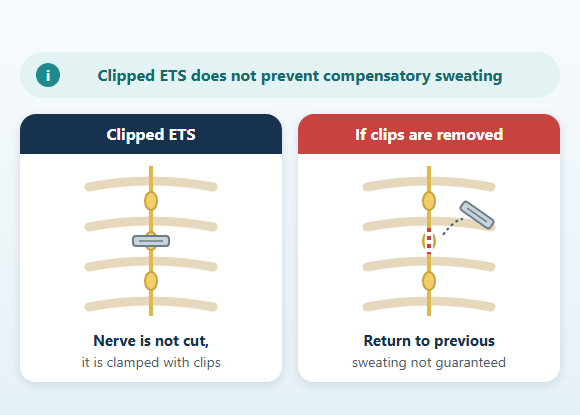
No. In ETS with clips, part of the sympathetic nerve pathway is compressed with surgical clips instead of being physically cut. Nevertheless, compensatory sweating can also develop after clipping. The fact that the clips can technically be removed later does not mean that the procedure is reliably or fully reversible.
Does Removing ETS Clips Correct Compensatory Sweating?
In people who have previously had ETS with clips, the surgical clips can technically be removed in another operation. However, removing the clips does not guarantee that the sweating pattern from before surgery will return. Long-term compression of the nerve may cause structural changes in the nerve tissue. After clip removal:- Compensatory sweating may continue
- Some people may see a partial change
- The original hyperhidrosis may return
- The target area may remain dry
Can Sympathetic Nerve Repair Reverse Compensatory Sweating?
Surgical methods aimed at reconnecting previously interrupted sympathetic nerves have been described. These procedures may use techniques such as direct nerve repair or nerve grafts. However, the sympathetic nervous system is not a simple structure consisting of a single nerve cable. After the initial surgery, changes may occur in:- The nerve tissue
- The surrounding scar tissue
- The broader regulation of the autonomic nervous system
Can Additional Sympathetic Surgery Treat Compensatory Sweating?
Additional surgical intervention at different or lower levels of the sympathetic nervous system has also been investigated as a way to reduce compensatory sweating. However, a new sympathetic surgery may cause new changes in the autonomic nervous system and the sweating pattern. Possible problems include:- Persistence of existing compensatory sweating
- New areas of sweating appearing
- New permanent autonomic changes
- Surgery being technically more difficult because of scar tissue from the previous operation
- Bleeding
- Lung injury
- Nerve-related complications
Why Are Previous Surgical Records Important?
The term “ETS” may be used for different surgical techniques. For this reason, details of the initial operation can be useful when evaluating compensatory sweating. Records that may be reviewed include:- The operative report
- The discharge summary
- The anatomical levels treated
- Whether the nerve was cut
- Whether electrocautery was used
- Whether clips were applied
- The number and position of the clips
- Surgical photographs or images, if available
- Previous follow-up records
How Is Compensatory Sweating Diagnosed?
The evaluation is usually based on a history of previous sympathetic surgery, a new sweating pattern that developed after surgery, and clinical assessment. Information that may be taken into account includes:- The date of the initial surgery
- The type of hyperhidrosis the surgery was performed for
- The areas treated
- The surgical technique used
- The time between surgery and the onset of new sweating
- The body areas with new sweating
- The severity and frequency of sweating
- Its relationship to heat and physical activity
- Whether it continues during sleep
- Its impact on daily life
- Whether sweating has returned in the area targeted by surgery
- Current medications
- Newly developed illnesses
Should Other Causes of Sweating Also Be Investigated?
Yes. Having had ETS does not mean that every sweating complaint that appears later is necessarily related to the surgery. Evaluating other causes may become important in the following situations:- Sweating that starts suddenly years after surgery
- Development of heavy night sweats
- Fever
- Unexplained weight loss
- Palpitations or tremor
- Marked fatigue
- Starting a new medication
- Sweating spreading over the whole body
- Other new accompanying symptoms
- Depending on the clinical findings:
- Blood sugar
- Thyroid function
- Blood count
- Current medications
- Other targeted tests
Can a Sweating Diary or Sweating Map Be Helpful?
Recording the distribution and triggers of sweating can help in evaluating the symptoms. In a sweating diary, the following can be noted:- The time sweating began
- The ambient temperature
- Physical activity
- The areas affected
- The severity of sweating
- The need to change clothes
- Foods eaten
- Medications taken
- Whether sweating occurs during sleep
How Is Compensatory Sweating Treated?
There is no single treatment that reliably and completely eliminates compensatory sweating in everyone. The approach depends on:- The severity of sweating
- The areas affected
- The size of the sweating area
- Its impact on daily life
- Coexisting conditions
- Current medications
- Treatments used previously
- How well possible side effects can be tolerated
- Adjustments to surroundings and clothing
- Antiperspirants for limited areas
- Certain topical medications
- Certain oral medications
- Botulinum toxin for limited areas
- Iontophoresis in selected cases
- Treatment of accompanying skin problems
- Supportive psychological approaches when social or psychological effects are significant
Clothing and Environmental Adjustments
Lifestyle adjustments do not reverse the change that sympathetic surgery has caused in the nervous system. However, they can help reduce the daily impact of the symptoms. These may include:- Wearing breathable clothing
- Dressing in thinner layers
- Changing out of wet clothing
- Using absorbent undergarments when appropriate
- Improving air circulation in the workplace
- Taking breaks in cooler areas in hot conditions
- Exercising during cooler hours
- Not leaving the skin wet for long periods
- Identifying personal triggers
Do Hot Weather and Climate Affect Compensatory Sweating?
Compensatory sweating may be more noticeable in hot and humid environments. Supportive measures may include:- Keeping indoor spaces cool
- Avoiding prolonged direct exposure to heat
- Exercising during the cooler hours of the day
- Choosing light, breathable clothing
- Maintaining adequate fluid intake during physical activity
- Reducing time spent in enclosed, poorly ventilated spaces
Can Antiperspirants Be Used for Compensatory Sweating?
Antiperspirants containing aluminum salts can temporarily act on the sweat ducts and reduce the amount of sweat reaching the skin surface. These products are mainly used when sweating is concentrated in a limited area. When compensatory sweating affects large areas such as the chest, back, and abdomen, applying antiperspirant to the entire area may not be practical and may increase the risk of skin irritation. Possible side effects include:- Burning
- Itching
- Redness
- Dryness
- Peeling
- Irritation
Topical Medications
Certain topical medications that aim to reduce the nerve signals reaching the sweat glands may be considered for limited areas of compensatory sweating. When applied to large areas of the body, systemic absorption of the medication may increase. Possible side effects include:- Dry mouth
- Blurred vision
- Pupil dilation if the medication comes into contact with the eye
- Constipation
- Difficulty urinating
- Skin irritation
Oral Medications
Certain systemic anticholinergic medications can reduce the nerve stimulation of the sweat glands. They may be considered in some cases when compensatory sweating affects large areas. However, these medications can affect sweat production throughout the body, not only in the problem area. Possible side effects include:- Dry mouth
- Constipation
- Blurred vision
- Dry eyes
- Difficulty urinating
- Changes in heart rate
- Drowsiness
- Problems with concentration
- Difficulty regulating body temperature
Can Botulinum Toxin Be Used for Compensatory Sweating?
Botulinum toxin aims to temporarily reduce the chemical signaling between certain nerve endings and the sweat glands. It may be considered when compensatory sweating is concentrated in a small, limited area. However, compensatory sweating usually affects a large part of the trunk. Because treating large areas may require a great many injections, it may not be practical for everyone. The effect of botulinum toxin is not permanent and wears off over time.Is Iontophoresis Used for Compensatory Sweating?
Iontophoresis is a method used mainly for hand and foot hyperhidrosis. Although different approaches have been tried for limited areas of the trunk, applying it to the chest, back, and abdomen is technically more difficult than to the palms and soles. Current data on its effectiveness for compensatory sweating are limited. For this reason, it is not considered a standard treatment for every case of compensatory sweating.Can Compensatory Sweating Cause Skin Problems?
Constant moisture can affect the skin barrier. As a result, the following may occur:- Irritation
- Itching
- Chafing
- Heat rash
- Fungal infections
- Bacterial infections
- Odor
- Changes in skin color
What Are the Psychological and Social Effects of Compensatory Sweating?
Severe compensatory sweating can have a significant impact on daily life. A person who had excessive sweating only on the hands before surgery may find it difficult to adapt when they experience new sweating over a large part of the trunk after surgery. As a result, the following may occur:- Disappointment
- Regret about the surgery
- Anxiety
- Avoidance of social settings
- Difficulty working in hot environments
- Changes in exercise habits
- Changes in clothing choices
- Emotional strain
Can Compensatory Sweating Be Prevented Before ETS?
There is no method that definitively prevents compensatory sweating. Before sympathetic surgery, factors such as the following may be taken into account:- Assessment of whether the hyperhidrosis is primary or secondary
- The severity of the initial symptoms
- Non-surgical methods tried previously
- Existing trunk sweating
- General health
- The climate the person lives in
- Occupation and level of physical activity
- The extent of the planned sympathetic nerve intervention
Why Is Follow-Up After Treatment Important?
Follow-up after sympathetic surgery should not focus only on whether the original target area is dry. During follow-up, the following may be evaluated:- The distribution of compensatory sweating
- The severity of sweating
- Its relationship to heat and activity
- The need to change clothes
- Skin problems
- Side effects of medications used
- Return of the original hyperhidrosis
- Gustatory sweating
- Excessive dryness
- Chest- or nerve-related symptoms
- Work capacity
- Social life
- Psychological effects
When Is Medical Evaluation Important?
Medical evaluation may become important if new or increased sweating after ETS significantly affects daily life. Other causes of sweating should also be evaluated in the following situations:- Sweating that starts suddenly long after surgery
- Heavy night sweats
- Fever
- Unexplained weight loss
- Palpitations or tremor
- Marked fatigue
- Starting a new medication
- Sweating accompanied by chest pain or shortness of breath
- Sweating that is predominantly on one side
- Development of skin wounds, infection, or discharge
Frequently Asked Questions About Compensatory Sweating
What is compensatory sweating after ETS?
Compensatory sweating is new or increased sweating in areas of the body that previously sweated less, occurring after ETS or another sympathetic nerve surgery. It most commonly affects the back, chest, abdomen, lower back, buttocks, groin, and legs.
How common is compensatory sweating after ETS?
Reported rates vary widely between studies. In a meta-analysis published in 2025, the overall rate of compensatory hyperhidrosis was calculated at approximately 62%. In studies assessing severe compensatory hyperhidrosis, a rate of approximately 23% was found. These figures can vary considerably depending on the surgical technique, the patient group, and the definitions used.
Does compensatory sweating go away over time?
The course varies from person to person. Some people report that their symptoms become less bothersome over time or that they adapt better to the new sweating pattern. In others, the sweating may continue for many years. It is not possible to predict in advance whether it will resolve completely on its own.
Where does compensatory sweating occur most often?
It most often occurs on the back, chest, abdomen, lower back, buttocks, groin, and legs. In some people only a limited area is affected, while in others the sweating may spread over a large part of the trunk and lower body.
Why does compensatory sweating occur after ETS?
The exact mechanism is not fully known. ETS alters part of the sympathetic nerve pathways that regulate sweating. As a result, changes may occur in how the autonomic nervous system regulates sweating and in sweat production in other areas of the body.
Can compensatory sweating be treated?
There is no single treatment that gives a definitive result for everyone. Depending on the severity and distribution of sweating, clothing and environmental adjustments, antiperspirants, certain topical or oral medications, botulinum toxin for limited areas, and treatment of accompanying skin problems may be considered.
Does removing ETS clips cure compensatory sweating?
Removing the clips does not guarantee that the sweating pattern from before surgery will return. Although some studies have reported partial improvement, in some people the sweating may continue or the original hyperhidrosis may return. Existing studies include limited numbers of patients, and their results vary.
Can sympathetic nerve repair reverse ETS?
Methods such as sympathetic nerve reconstruction or nerve grafting have been described, but the current scientific evidence is limited. Anatomically reconnecting the nerve does not guarantee that the nerve function or sweating pattern from before surgery will return. For this reason, it is not considered a standard reversal treatment with a predictable outcome.
Who is at higher risk of severe compensatory sweating?
Individual risk cannot be predicted with certainty. Research has examined factors such as age, body mass index, smoking history, and the characteristics of the initial sympathetic surgery. In the 2025 meta-analysis, a higher body mass index was found to be associated with severe compensatory hyperhidrosis. However, none of these factors alone shows who will experience severe sweating.
Can compensatory sweating be prevented before ETS?
There is no surgical technique or preoperative test that definitively prevents compensatory sweating. Accurately assessing the type of hyperhidrosis, reviewing non-surgical options, taking existing trunk sweating into account, and considering the long-term effects of sympathetic surgery are all part of the preoperative decision-making process.
Disclaimer: The information on this website has been prepared to inform the public about health topics. The content is not intended to provide a personal diagnosis, recommend a specific treatment, or replace a medical examination. The evaluation of compensatory sweating may vary depending on the characteristics of the previous surgery, the distribution and severity of the sweating, and the person's general health. Please consult your physician about your personal health situation.