Treatment Options for COPD and Emphysema
Inhaled medications, pulmonary rehabilitation, oxygen, endobronchial valves, lung volume reduction surgery and transplantation options in the treatment of COPD and emphysema.
What Is Lung Cancer? Symptoms, Diagnosis and Surgical Treatment
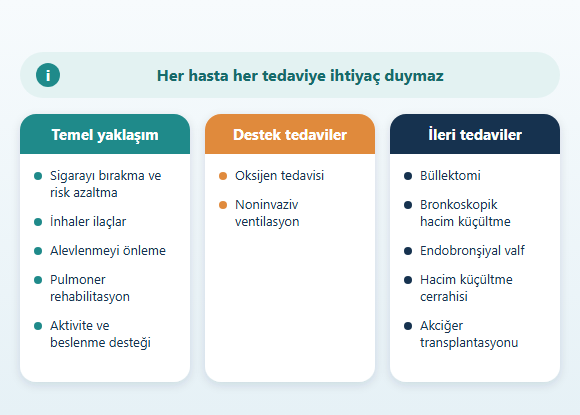
Treatment for COPD and emphysema does not consist of a single medication, procedure or operation. Treatment is planned by taking into account the severity of the disease, its predominant features, the degree of shortness of breath, the history of exacerbations, lung function, the distribution of emphysema within the lungs, hyperinflation and the person's general health.
Although COPD and emphysema are closely related, they are not the same thing.
COPD is a broad clinical group of diseases characterized by persistent airflow limitation. Emphysema, on the other hand, is an anatomical condition in which the walls of the alveoli are damaged and the elastic structure of the lung tissue is impaired.
For this reason, although there may be common approaches in the early stages of treatment, the treatments that can be applied, especially in advanced disease, may differ.
Treatment options can generally be considered under the following headings:
- Quitting smoking and reducing risk factors
- Inhaled medication therapies
- Preventing exacerbations
- Pulmonary rehabilitation
- Physical activity and nutritional support
- Oxygen therapy
- Noninvasive ventilation
- Bullectomy
- Bronchoscopic lung volume reduction
- Endobronchial valve
- Lung volume reduction surgery
- Lung transplantation
What Are the Main Goals of COPD and Emphysema Treatment?
The goal of treatment is not simply to change the values on pulmonary function tests.
The main goals can be listed as follows:
The scope of treatment may change as the disease progresses.
The main goals can be listed as follows:
- Reducing shortness of breath
- Supporting daily physical capacity
- Reducing exacerbations
- Reducing the risk of hospitalization
- Reducing the effects of air trapping and hyperinflation
- Supporting gas exchange
- Limiting the loss of muscle and physical capacity
- Preserving quality of life as much as possible
- Identifying advanced treatment options in suitable patients
The scope of treatment may change as the disease progresses.
How Is the Treatment Plan Determined?
In the treatment of COPD and emphysema, the name of the disease or the FEV1 value alone is not sufficient.
The evaluation may consider the following together:
When advanced treatments are being considered, the anatomical and physiological evaluation becomes more detailed.
The evaluation may consider the following together:
- Severity of symptoms
- Impact of shortness of breath on daily life
- FEV1 and other spirometry results
- Lung volumes
- Residual volume
- Hyperinflation
- DLCO
- Oxygen level
- Carbon dioxide level
- Frequency of exacerbations
- Hospitalizations
- Computed tomography findings
- Extent and distribution of emphysema
- Exercise capacity
- Smoking
- Nutritional and muscle status
- Coexisting conditions
When advanced treatments are being considered, the anatomical and physiological evaluation becomes more detailed.
Why Is Quitting Smoking the Foundation of Treatment?
If a person is still smoking, quitting is one of the most important steps in the treatment of COPD and emphysema.
Quitting smoking:
Quitting smoking:
- May reduce ongoing lung damage
- May slow the rate of lung function loss
- May reduce the risk of exacerbations
- May lower the risk of lung cancer
- May reduce the risk of cardiovascular disease
Inhaled Medication Therapies
Inhaled therapies are one of the core components of COPD treatment.
Different groups of bronchodilator medications may be used in treatment.
These may include:
The choice of treatment is not based solely on whether the COPD is advanced. Clinical features such as symptoms, history of exacerbations, response to previous treatment and blood eosinophil levels, as well as coexisting conditions, may be taken into account.
These may include:
- Long-acting beta-2 agonists
- Long-acting anticholinergic medications
- Combinations of two bronchodilators used together
- Combinations containing inhaled corticosteroids in suitable patients
The choice of treatment is not based solely on whether the COPD is advanced. Clinical features such as symptoms, history of exacerbations, response to previous treatment and blood eosinophil levels, as well as coexisting conditions, may be taken into account.
Are Inhaled Corticosteroids Used in Every COPD Patient?
No.
Inhaled corticosteroids are not medications that every COPD patient should routinely use.
In particular, factors such as the following are evaluated:
For this reason, the content of inhaled therapy may vary from person to person.
In particular, factors such as the following are evaluated:
- History of exacerbations
- Blood eosinophil level
- Coexisting asthma features
- Response to previous treatment
- Risk of pneumonia
For this reason, the content of inhaled therapy may vary from person to person.
Why Is Inhaler Technique Important?
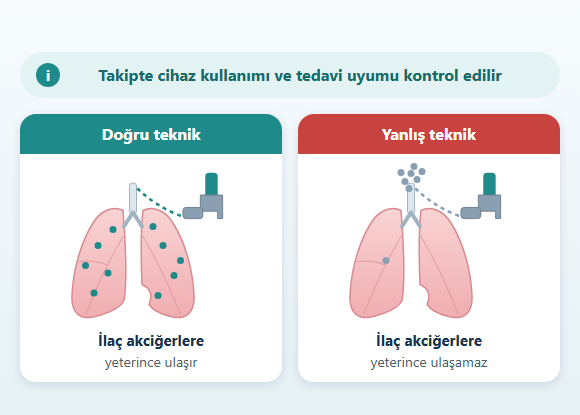
Even when the right medication has been chosen, using the inhaler device incorrectly can prevent a sufficient amount of the medication from reaching the lungs.
For this reason, the following should be assessed during follow-up:
Sometimes, in a patient whose treatment is thought to be inadequate, the underlying problem may be incorrect inhaler technique.
For this reason, the following should be assessed during follow-up:
- Correct use of the device
- Regular use of the medication
- The patient's physical ability to use the device
- Inhalation strength
- Adherence to treatment
Sometimes, in a patient whose treatment is thought to be inadequate, the underlying problem may be incorrect inhaler technique.
Preventing Exacerbations
One of the key goals of COPD treatment is to reduce exacerbations.
The following may be important in reducing the risk of exacerbations:
Additional medications may also be considered in selected patients with recurrent exacerbations.
The following may be important in reducing the risk of exacerbations:
- Appropriate inhaled therapy
- Correct inhaler use
- Quitting smoking
- Assessing vaccination needs
- Pulmonary rehabilitation
- Physical activity
- Control of coexisting conditions
Additional medications may also be considered in selected patients with recurrent exacerbations.
What Is Pulmonary Rehabilitation?
Pulmonary rehabilitation is not simply an exercise program.
The program may include:
Pulmonary rehabilitation does not rebuild damaged lung tissue. However, it can help a person use their existing respiratory capacity more efficiently and reduce the loss of physical conditioning.
The program may include:
- Endurance exercises
- Muscle strengthening
- Breathing techniques
- Physical activity training
- Disease education
- Inhaler training
- Nutritional assessment
- Energy conservation techniques
Pulmonary rehabilitation does not rebuild damaged lung tissue. However, it can help a person use their existing respiratory capacity more efficiently and reduce the loss of physical conditioning.
Why Is Pulmonary Rehabilitation Important Before Advanced Treatments?
In patients with advanced emphysema who are being evaluated for bronchoscopic or surgical volume reduction, pulmonary rehabilitation is not merely a supportive treatment.
After rehabilitation, the following may be reassessed:
In some patients, the clinical condition may improve significantly with rehabilitation. It may also help increase the physical reserve of patients who will undergo a procedure.
After rehabilitation, the following may be reassessed:
- Shortness of breath
- Walking capacity
- Exercise tolerance
- Muscle strength
- Overall functional status
In some patients, the clinical condition may improve significantly with rehabilitation. It may also help increase the physical reserve of patients who will undergo a procedure.
Why Is Physical Activity Important?
People who experience shortness of breath may gradually reduce their physical activity over time.
This can create a cycle:
For this reason, physical activity suited to the person's health and capacity is an important part of treatment.
This can create a cycle:
- Shortness of breath → less movement → muscle loss → lower exercise capacity → more shortness of breath
For this reason, physical activity suited to the person's health and capacity is an important part of treatment.
The Importance of Nutrition and Muscle Loss in Treatment
In advanced COPD and emphysema, some people may develop:
On the other hand, excess weight can also increase the work of breathing and limit mobility. For this reason, in advanced disease, not only body weight but also muscle mass and overall nutritional status are assessed.
- Weight loss
- Reduced muscle mass
- Protein and energy deficiency
- Physical frailty
On the other hand, excess weight can also increase the work of breathing and limit mobility. For this reason, in advanced disease, not only body weight but also muscle mass and overall nutritional status are assessed.
Who Receives Oxygen Therapy?
A diagnosis of COPD or emphysema alone is not sufficient to start oxygen therapy.
Long-term oxygen therapy is considered in selected patients with objectively documented, significant and persistent hypoxemia.
The evaluation may use:
Oxygen therapy is not used indiscriminately to treat the sensation of breathlessness.
The evaluation may use:
- Pulse oximetry
- Arterial blood gas
- Oxygen level at rest
- Oxygen level during exercise
- Measurements during sleep when necessary
Oxygen therapy is not used indiscriminately to treat the sensation of breathlessness.
What Is Noninvasive Ventilation?
Noninvasive ventilation (NIV) is a method that provides positive-pressure breathing support through a mask.
It is an important treatment option, particularly for patients who develop hypercapnic respiratory failure during an acute COPD exacerbation.
Long-term home NIV may also be considered in selected patients with advanced COPD and chronic hypercapnia.
NIV:
NIV:
- May reduce the workload of the respiratory muscles
- May support ventilation
- May help remove carbon dioxide
Why May Treatment Differ in Emphysema?
When emphysema is prominent, the problem is not only the narrowing of the airways.
Due to the loss of elasticity in the lung tissue, the following may become significant:
For this reason, in selected patients whose severe hyperinflation persists despite standard COPD treatment, advanced methods aimed at reducing lung volume may be considered.
Due to the loss of elasticity in the lung tissue, the following may become significant:
- Air trapping
- Hyperinflation
- Flattening of the diaphragm
- Mechanical disadvantage of the respiratory muscles
For this reason, in selected patients whose severe hyperinflation persists despite standard COPD treatment, advanced methods aimed at reducing lung volume may be considered.
What Is Bullectomy?
In some patients, emphysema can lead to the formation of large air-filled spaces called bullae.
A large bulla may be evaluated for bullectomy if it:
During bullectomy, the goal is to remove the distinct large bulla. For this reason, bullectomy and the lung volume reduction surgery performed for diffuse emphysema are not the same procedure.
A large bulla may be evaluated for bullectomy if it:
- Takes up significant space in the chest cavity
- Compresses better-functioning lung tissue
- Contributes to shortness of breath
- Is associated with recurrent pneumothorax
- Is associated with recurrent infections
During bullectomy, the goal is to remove the distinct large bulla. For this reason, bullectomy and the lung volume reduction surgery performed for diffuse emphysema are not the same procedure.
What Is Bronchoscopic Lung Volume Reduction?
Bronchoscopic lung volume reduction methods aim to reduce the volume of selected overinflated areas of the lung using a bronchoscope, without surgically opening the chest.
In this field, the method with the strongest scientific evidence is the placement of one-way endobronchial valves.
Other methods that have been studied over time may include:
The level of evidence and clinical use of these methods differ from one another.
Other methods that have been studied over time may include:
- Coil systems
- Thermal vapor application
- Biological volume reduction methods
- Chemical methods
- Various airway implants
The level of evidence and clinical use of these methods differ from one another.
What Is Endobronchial Valve Treatment?
Endobronchial valves are small one-way devices placed with a bronchoscope into the airways leading to a selected target lobe.
The purpose of the valves is to:
As the target lobe shrinks:
The purpose of the valves is to:
- Allow air in the target lobe to flow out
- Reduce the entry of new air
- Reduce the volume of the target lobe
As the target lobe shrinks:
- Hyperinflation may decrease
- The diaphragm may move into a more favorable position
- Better-preserved areas of the lung may expand
- Breathing mechanics may improve
Who May Be Considered for Endobronchial Valves?
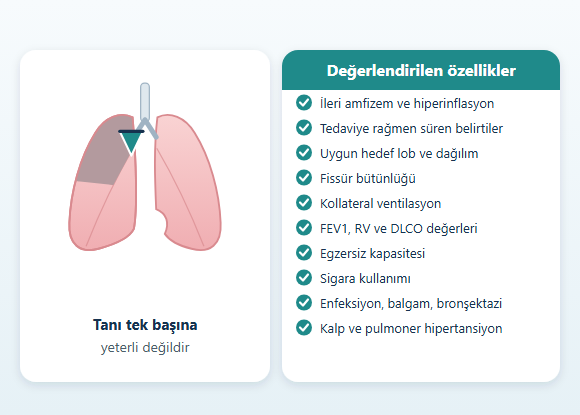
Patient selection is critical in valve treatment.
Factors that may be evaluated include:
Therefore, a diagnosis of “advanced COPD” or “advanced emphysema” alone is not sufficient for valve placement.
Factors that may be evaluated include:
- Advanced emphysema
- Significant hyperinflation
- Severe symptoms that persist despite optimal medical treatment
- A suitable target lobe
- Distribution of emphysema between the lobes
- Fissure integrity
- Collateral ventilation
- FEV1
- Residual volume
- DLCO
- Exercise capacity
- Smoking
- Bronchiectasis
- Infection
- Amount of sputum
- Cardiac status
- Pulmonary hypertension
Therefore, a diagnosis of “advanced COPD” or “advanced emphysema” alone is not sufficient for valve placement.
Why Is Collateral Ventilation Important?
Endobronchial valves close off the normal airways leading to the target lobe. However, if air continues to enter the target lobe through alternative connections from neighboring lobes, this is called collateral ventilation. If there is significant collateral ventilation, the target lobe may not shrink sufficiently despite valve placement. For this reason, the following may be used in patient selection:- Assessment of fissure integrity on CT
- Bronchoscopic measurement of collateral ventilation when necessary
What Are the Risks of Endobronchial Valves?
Although valve treatment does not require a surgical incision, it is not a risk-free procedure. Possible complications include:- Pneumothorax
- COPD exacerbation
- Pneumonia
- Bleeding
- Increased sputum
- Valve displacement
- Valve blockage
- Tissue growth around the valve
- Insufficient shrinkage of the target lobe
- Respiratory failure
- Need for additional bronchoscopy
- Need for valve removal
Can Endobronchial Valves Be Removed?
When necessary, valves can usually be removed bronchoscopically. Removal may be needed because of:- Inadequate clinical response
- Infection
- Valve migration
- Airway reaction
- Other complications
What Is Lung Volume Reduction Surgery?
Lung volume reduction surgery is the surgical removal of the most severely damaged areas of the lung in advanced emphysema that contribute significantly to hyperinflation. The aim here is not only to remove damaged tissue. The main goals are to:- Reduce hyperinflation
- Improve the mechanical position of the diaphragm
- Allow better-functioning lung tissue to expand
- Increase the efficiency of the respiratory muscles
Who May Be a Candidate for Lung Volume Reduction Surgery?
In patient selection, the following are evaluated together:- Extent of emphysema
- Distribution of emphysema
- Heterogeneous or homogeneous pattern
- Degree of hyperinflation
- FEV1
- Residual volume
- DLCO
- Exercise capacity
- Condition after pulmonary rehabilitation
- Smoking
- Heart disease
- Pulmonary hypertension
- Nutritional status
- Overall surgical risk
What Are the Risks of Lung Volume Reduction Surgery?
Possible complications may include:- Prolonged air leak
- Pneumothorax
- Pneumonia
- Bleeding
- Respiratory failure
- Heart rhythm disorders
- Thromboembolic complications
- Need for intensive care
- Reoperation
- Death
What Is the Difference Between Endobronchial Valves and Surgery?
Both approaches may aim to reduce hyperinflation, but their methods are different. Endobronchial valve:- Is performed bronchoscopically
- Does not involve surgical removal of lung tissue
- Requires a suitable target lobe
- Is significantly affected by collateral ventilation
- The devices can be removed if necessary
- Directly removes damaged lung tissue
- Is a surgical procedure
- Is not as dependent on collateral ventilation as valves
- May involve a greater surgical burden and recovery period
What Is the “COPD Balloon”?
The bronchoscopic approach referred to as the “COPD balloon” does not have the same mechanism as endobronchial valves or lung volume reduction surgery. This method is primarily an approach that targets the airways. The COPD balloon:- Does not remove emphysematous lung tissue
- Does not rebuild damaged alveoli
- Does not reduce target lobe volume as endobronchial valves do
- Is not a substitute for lung volume reduction surgery
Other Bronchoscopic Methods
In addition to valves, other bronchoscopic methods have also been studied for the treatment of emphysema.Coil Treatment
This method is based on the bronchoscopic placement of shape-memory devices into the lung tissue. The aim is to mechanically compress overinflated tissue and support lung elasticity.Thermal Vapor Treatment
This method is based on applying controlled heated water vapor to selected areas of the lung. Following the controlled inflammatory response that is created, tissue remodeling and volume reduction are targeted.Other Methods
Biological, chemical and various implant-based methods have also been studied. The level of evidence, availability and place of these methods in routine clinical practice are not the same.When Is Lung Transplantation Considered?
Lung transplantation may be considered in selected patients with very advanced, irreversible COPD or emphysema. When transplantation is being considered, the following may be evaluated:- Optimal medical treatment
- Pulmonary rehabilitation
- Oxygen requirement
- Elevated carbon dioxide
- Exercise capacity
- Frequency of exacerbations
- Hospitalizations
- Pulmonary hypertension
- Suitability for volume reduction options
- Overall course of the disease
How Is the Appropriate Treatment Decided?
In the treatment of COPD and emphysema, the choice of advanced treatment is not based on a single test. For example, severe shortness of breath in a patient is not sufficient on its own for an endobronchial valve. Similarly, the presence of advanced emphysema on CT does not automatically mean that surgery is required. In choosing treatment, the following are evaluated together:- The predominant mechanism of the disease
- Airway obstruction
- Hyperinflation
- Distribution of emphysema
- Presence of a target lobe
- Fissure integrity
- Collateral ventilation
- FEV1
- DLCO
- Lung volumes
- Exercise capacity
- Response to previous treatments
- General health
Are Medical, Bronchoscopic and Surgical Treatments Alternatives to Each Other?
Not always. The treatment of COPD and emphysema is mostly stepwise and complementary. For example, even in a patient who will undergo an advanced procedure, the following remain important:- Quitting smoking
- Inhaled therapies
- Pulmonary rehabilitation
- Physical activity
- Preventing exacerbations
How Should Treatment Expectations Be Set?
In the treatment of COPD and emphysema, the goal is not always to bring lung function back to completely normal. Especially in advanced disease, realistic goals may include:- Less shortness of breath
- A longer walking distance
- Carrying out daily activities more easily
- Fewer exacerbations
- Reduced hyperinflation
- Preserving physical independence as much as possible
Frequently Asked Questions About COPD and Emphysema Treatment
Can COPD be completely cured?
COPD is a chronic disease. Structural lung damage that has already occurred is not expected to return completely to normal. Treatment aims to slow the progression of the disease, control symptoms and reduce exacerbations.
Can emphysema be reversed with medication?
Medications can help control the accompanying airway narrowing and symptoms, but they do not rebuild damaged alveolar walls.
Should every COPD patient use oxygen?
No. Long-term oxygen therapy is considered in selected patients with objectively documented, significant and persistent low oxygen levels.
Can pulmonary rehabilitation be beneficial in advanced disease?
Yes. In suitable patients, it can be important for increasing physical capacity, reducing muscle loss and lessening the impact of shortness of breath on daily life.
Can every patient with advanced emphysema receive endobronchial valves?
No. Criteria such as a suitable target lobe, significant hyperinflation, fissure anatomy and collateral ventilation are important in patient selection.
Do valve treatment and lung volume reduction surgery aim for the same result?
Both approaches may aim to reduce hyperinflation in selected patients, but they achieve this through different methods. Their eligibility criteria and risks also differ.
Which patients may be considered for bullectomy?
It may be considered in selected patients in whom a large bulla compresses the surrounding, better-functioning lung tissue or is associated with problems such as pneumothorax and infection.
Is the COPD balloon an alternative to endobronchial valves?
It should not be considered a direct alternative. The two methods target different mechanisms and different disease characteristics.
When is lung transplantation considered?
Transplant evaluation may be performed in selected patients with very advanced, irreversible disease whose severe disease burden persists despite standard and appropriate advanced treatments.
What is the best treatment for COPD or emphysema?
No single treatment is suitable for all patients. Treatment is chosen individually based on the type and severity of the disease, the characteristics of emphysema and hyperinflation, lung function, symptoms and general health.
Conclusion
Treatment for COPD and emphysema does not consist of a single method. The treatment process is carried out in steps according to the characteristics of the disease.The basic treatment approach may include:
- Quitting smoking
- Appropriate inhaled therapies
- Preventing exacerbations
- Pulmonary rehabilitation
- Physical activity
- Nutritional assessment
- Oxygen therapy when necessary
- Noninvasive ventilation in selected patients
In selected patients with advanced emphysema and significant hyperinflation, the following may be considered:
- Bullectomy
- Endobronchial valve
- Lung volume reduction surgery
- Other selected bronchoscopic methods
In suitable patients with very advanced, irreversible disease, lung transplantation may come into consideration as a separate treatment option. None of these methods is applied simply because a diagnosis of “COPD” or “emphysema” is present. In choosing advanced treatment, anatomical and physiological evaluation should be carried out together. The distribution of emphysema, hyperinflation, fissure anatomy, collateral ventilation, lung function, exercise capacity, response to previous treatments and general health may determine the suitability of different treatment options. For this reason, the fundamental approach in the treatment of COPD and emphysema is not to apply a single method to the disease, but to identify the mechanism the disease creates in each person and select the appropriate treatment steps.
Disclaimer: The information on this page has been prepared for general informational purposes and does not replace a medical examination, diagnosis or a personalized treatment plan. The methods that may be used in the treatment of COPD and emphysema are evaluated individually by a physician based on the severity and characteristics of the disease, lung function, the distribution of emphysema, hyperinflation, imaging findings, exercise capacity, previous treatments and the person's general health.