Advanced-Stage COPD
What Is Advanced-Stage COPD? Information on Shortness of Breath, Respiratory Failure, Oxygen and NIV Therapy, Pulmonary Rehabilitation and Advanced Treatment Options.
What Is Advanced-Stage COPD? Symptoms, Treatment and Advanced Treatment Options
Advanced-stage chronic obstructive pulmonary disease (COPD) is an advanced chronic lung condition in which airflow limitation becomes pronounced, shortness of breath affects daily life to a greater extent, and in some patients problems such as exacerbations, low oxygen levels, elevated carbon dioxide or respiratory failure may develop.
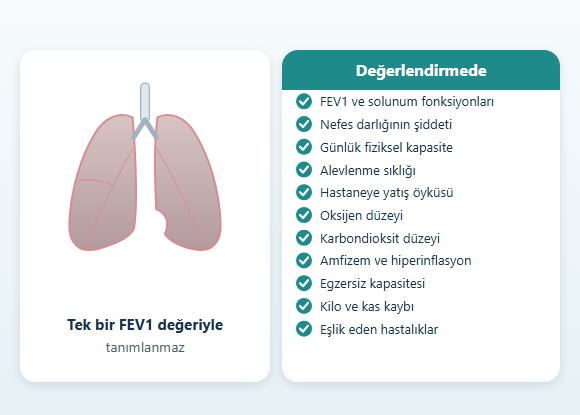
However, “advanced-stage COPD” is not defined by a single value on a pulmonary function test.
The evaluation takes the following into account together:
- FEV1 and other measures of lung function
- Severity of shortness of breath
- Daily physical capacity
- Frequency of exacerbations
- History of hospitalization
- Oxygen level
- Carbon dioxide level
- Emphysema and hyperinflation in the lungs
- Exercise capacity
- Weight and muscle loss
- Coexisting heart and other organ diseases
What Does Advanced-Stage COPD Mean?
COPD is a lung disease that can be chronic and progressive.
As the disease progresses, airway narrowing, small airway damage, emphysema, air trapping and overinflation of the lungs may become pronounced to varying degrees.
In advanced disease:
Smoking, exacerbations, genetic factors, coexisting conditions, level of physical activity and adherence to treatment may affect the course of the disease.
In advanced disease:
- Breathing out may become more difficult
- Air trapping in the lungs may increase
- The workload of the respiratory muscles may increase
- Exercise capacity may decrease
- Shortness of breath may develop during daily activities
- Exacerbations may be more severe
- The balance of oxygen and carbon dioxide may be disrupted
- Respiratory failure may develop
Smoking, exacerbations, genetic factors, coexisting conditions, level of physical activity and adherence to treatment may affect the course of the disease.
Is Advanced-Stage COPD Determined by FEV1 Alone?
No.
FEV1 shows the amount of air that can be exhaled in the first second of a forceful breath out, and it is important for assessing the degree of airflow limitation.
However, FEV1 alone does not fully reflect:
For this reason, in the evaluation of advanced COPD, pulmonary function tests are interpreted together with clinical findings.
However, FEV1 alone does not fully reflect:
- The severity of shortness of breath
- Capacity for daily living
- The risk of exacerbations
- Oxygen level
- Hyperinflation
- Exercise capacity
- Quality of life
- The overall burden of disease
For this reason, in the evaluation of advanced COPD, pulmonary function tests are interpreted together with clinical findings.
What Are the Symptoms of Advanced-Stage COPD?
The most prominent symptom in advanced COPD is shortness of breath.
Possible symptoms may include:
In more advanced disease, additional symptoms related to low oxygen or elevated carbon dioxide levels may develop.
Possible symptoms may include:
- Shortness of breath when walking
- Marked difficulty climbing stairs
- Needing to stop frequently while doing daily tasks
- Shortness of breath while getting dressed or showering
- Walking more slowly than peers
- A marked decrease in exercise capacity
- Chronic cough
- Sputum
- Wheezing
- A feeling of tightness in the chest
- Frequent respiratory infections
- Recurrent COPD exacerbations
- Fatigue
- Weight loss
- Muscle loss
In more advanced disease, additional symptoms related to low oxygen or elevated carbon dioxide levels may develop.
Why Does Shortness of Breath Increase in COPD?
There can be many causes of shortness of breath in COPD.
Because of airway narrowing, it may become harder for air to leave the lungs.
When not enough air can be exhaled, air builds up in the lungs.
This is called air trapping.
As air trapping increases, hyperinflation may develop.
In this case:
In this case:
- The lungs may become overinflated
- The diaphragm may flatten
- The respiratory muscles may work at a greater disadvantage
- More energy may be spent on each breath
- Dynamic hyperinflation may increase during exercise
What Is Hyperinflation?
Hyperinflation is a condition in which the lungs remain expanded with more air than normal because they cannot empty sufficiently during exhalation.
In advanced COPD, hyperinflation can be one of the major causes of shortness of breath.
Excess air buildup in the lungs:
Excess air buildup in the lungs:
- May impair the way the diaphragm works
- May reduce the efficiency of the respiratory muscles
- May create a feeling of fullness in the chest
- May reduce exercise tolerance
What Is an Exacerbation in Advanced COPD?
A COPD exacerbation is a marked worsening of shortness of breath, cough or sputum beyond the person's usual day-to-day variation.
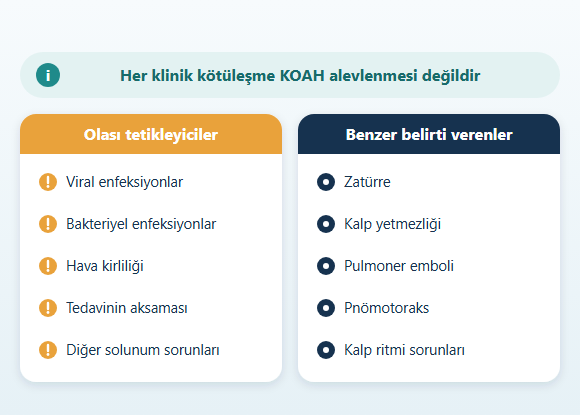
Exacerbations may be associated with:
Similar symptoms may also be seen in other conditions, such as:
Exacerbations may be associated with:
- Viral infections
- Bacterial infections
- Air pollution
- Interruptions in treatment
- Other respiratory problems
Similar symptoms may also be seen in other conditions, such as:
- Pneumonia
- Heart failure
- Pulmonary embolism
- Pneumothorax
- Heart rhythm problems
Why Are Frequent Exacerbations Important?
Recurrent COPD exacerbations can increase the overall burden of the disease.
Frequent or severe exacerbations:
Frequent or severe exacerbations:
- May accelerate the loss of lung function
- May reduce physical capacity
- May increase muscle loss
- May lead to hospitalizations
- May lower quality of life
- May increase the risk of respiratory failure
What Is Respiratory Failure in Advanced COPD?
Respiratory failure is a condition in which the lungs cannot adequately meet the body's need for gas exchange.
Two main problems may arise:
Hypoxemic Respiratory Failure
This is an insufficient level of oxygen in the blood.Hypercapnic Respiratory Failure
This is an elevated level of carbon dioxide in the blood. In some patients with advanced COPD, both conditions may occur together. Arterial blood gas testing can provide important information in the evaluation.How Does Advanced COPD Affect Oxygen Levels?
As COPD progresses, the oxygen level in the blood may fall due to airflow limitation, emphysema, impaired gas exchange and ventilation-perfusion mismatch.
Low oxygen levels may occur to different degrees:
Pulse oximetry is an important screening tool, but some patients may need a more detailed evaluation with arterial blood gas testing.
Low oxygen levels may occur to different degrees:
- At rest
- During exercise
- During sleep
- During exacerbations
Pulse oximetry is an important screening tool, but some patients may need a more detailed evaluation with arterial blood gas testing.
Why Does Carbon Dioxide Rise in COPD?
In advanced disease, the respiratory system may not be able to remove carbon dioxide adequately.
Factors that may contribute to this include:
With markedly elevated carbon dioxide, symptoms such as headache, drowsiness, difficulty concentrating or changes in consciousness may occur.
Factors that may contribute to this include:
- Severe airway obstruction
- Severe hyperinflation
- Fatigue of the respiratory muscles
- Inadequate ventilation
- Exacerbations
- Breathing disorders during sleep
With markedly elevated carbon dioxide, symptoms such as headache, drowsiness, difficulty concentrating or changes in consciousness may occur.
How Is Advanced-Stage COPD Evaluated?
The evaluation of advanced COPD is not based on a single test.
Tests that may be used include:
Which tests are needed is determined according to the person's clinical characteristics.
Tests that may be used include:
- Spirometry
- Lung volumes
- DLCO
- Pulse oximetry
- Arterial blood gas
- Computed tomography
- Chest X-ray
- Six-minute walk test
- Exercise assessment
- Cardiac evaluation
- Blood tests
- Sleep studies
Which tests are needed is determined according to the person's clinical characteristics.
What Does Spirometry Show in Advanced COPD?
Spirometry assesses airflow limitation.
The main measurements are:
In advanced disease, FEV1 may be significantly reduced. However, it is not possible to determine how much shortness of breath a person experiences, or which advanced treatment they may be suitable for, by looking at spirometry alone.
The main measurements are:
- FEV1
- FVC
- FEV1/FVC
In advanced disease, FEV1 may be significantly reduced. However, it is not possible to determine how much shortness of breath a person experiences, or which advanced treatment they may be suitable for, by looking at spirometry alone.
Why Are Lung Volumes Measured?
Lung volume measurements are particularly important for assessing air trapping and hyperinflation.
Values that can be measured include:
Significant hyperinflation may be important in evaluating certain bronchoscopic or surgical treatment options, particularly in patients with advanced emphysema.
Values that can be measured include:
- Residual volume
- Total lung capacity
- Functional residual capacity
Significant hyperinflation may be important in evaluating certain bronchoscopic or surgical treatment options, particularly in patients with advanced emphysema.
Why Is DLCO Important?
DLCO provides information about the capacity of gases to pass from the alveoli into the blood.
DLCO may be reduced, particularly in patients with prominent emphysema, due to the loss of alveolar surface area.
A low DLCO may indicate:
Impaired gas exchange
Possible limitation of physical capacity
Possibly increased risk for certain procedures
However, a low DLCO is not specific to COPD or emphysema.
Why Is Computed Tomography Performed in Advanced COPD?
Computed tomography provides important information for assessing the structural features of COPD.
On CT, the following can be evaluated:
When volume reduction methods for advanced emphysema are being considered, CT becomes even more important.
On CT, the following can be evaluated:
- Emphysema
- Distribution of emphysema
- Bullae
- Bronchiectasis
- Airway changes
- Lung nodules
- Infections
- Other lung diseases
When volume reduction methods for advanced emphysema are being considered, CT becomes even more important.
What Is the Six-Minute Walk Test in Advanced COPD?
The six-minute walk test is a functional test that assesses how far a person can walk within a set period of time.
During the test, the following may be monitored:
This test can provide information about a person's daily physical capacity that differs from what pulmonary function tests show.
During the test, the following may be monitored:
- Walking distance
- Shortness of breath
- Heart rate
- Oxygen level
This test can provide information about a person's daily physical capacity that differs from what pulmonary function tests show.
Why Are Weight and Muscle Loss Important in Advanced COPD?
Advanced COPD should not be regarded as a disease that affects only the lungs.
Some patients may develop:
Causes may include:
Muscle loss can further increase the impact of shortness of breath on daily life.
- Weight loss
- Reduced muscle mass
- Physical weakness
- Frailty
Causes may include:
- Increased energy expenditure for breathing
- Loss of appetite
- Reduced physical activity
- Recurrent exacerbations
- Chronic inflammation
- Long-term disease burden
Muscle loss can further increase the impact of shortness of breath on daily life.
How Is Advanced-Stage COPD Treated?
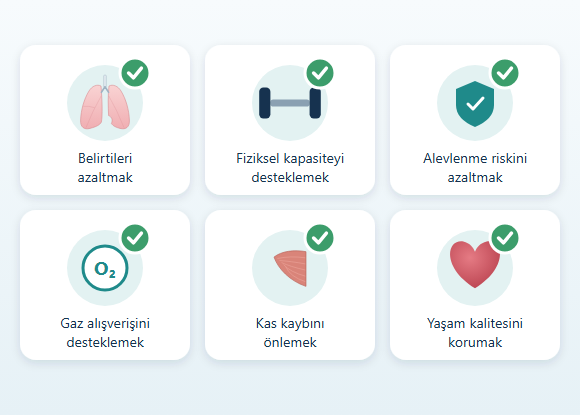
The goal of advanced COPD treatment is not simply to change the FEV1 value.
Treatment aims to:
Treatment is planned individually according to the characteristics of the person's COPD.
Treatment aims to:
- Reduce symptoms
- Support physical capacity
- Reduce the risk of exacerbations
- Support gas exchange
- Prevent muscle loss
- Preserve quality of life as much as possible
Treatment is planned individually according to the characteristics of the person's COPD.
Quitting Smoking
If a person is still smoking, quitting is one of the fundamental steps of treatment. Quitting smoking:- May reduce ongoing lung damage
- May slow the rate of lung function loss
- May reduce the risk of exacerbations
- May lower the risk of lung cancer
- May reduce the risk of cardiovascular disease
Inhaled Therapies
Long-acting bronchodilator inhaled medications play an important role in COPD treatment. Depending on the patient's characteristics, the following may be used:- Long-acting beta-2 agonists
- Long-acting anticholinergic medications
- Combinations containing inhaled corticosteroids in suitable patients
- Symptoms
- History of exacerbations
- Response to previous treatment
- Clinical features such as blood eosinophil level
- Coexisting conditions
Pulmonary Rehabilitation
Pulmonary rehabilitation is one of the important components of advanced COPD treatment. Programs generally may include:- Endurance exercises
- Muscle strengthening
- Breathing techniques
- Physical activity training
- Disease education
- Nutritional assessment
- Energy conservation techniques
Oxygen Therapy in Advanced COPD
Not every patient with advanced COPD needs to use oxygen. Long-term oxygen therapy is considered in selected patients whose significant and persistent hypoxemia has been demonstrated by objective measurements. Oxygen therapy is not started based solely on a person's sensation of breathlessness. The evaluation may use:- Pulse oximetry
- Arterial blood gas
- Measurements at rest
- Measurements during exercise
- Oxygen values during sleep when necessary
What Is Noninvasive Ventilation?
Noninvasive ventilation (NIV) is a method that provides positive-pressure breathing support through a mask. It is an important treatment option for patients who develop hypercapnic respiratory failure during an acute COPD exacerbation. Long-term home NIV may also be considered in selected patients with advanced COPD and chronic hypercapnia. Not every patient with advanced COPD is a suitable candidate for NIV. The decision is made based on blood gas results, clinical condition and accompanying features.How Can Exacerbations Be Prevented?
To reduce the risk of exacerbations, the following are important:- Adjusting to appropriate inhaled therapy
- Correct inhaler technique
- Quitting smoking
- Reviewing vaccinations
- Pulmonary rehabilitation
- Regular physical activity
- Control of coexisting conditions
Bronchoscopic Treatments in Advanced COPD
In some patients with advanced COPD, a major cause of shortness of breath may be advanced emphysema and hyperinflation. Bronchoscopic lung volume reduction methods may be considered in appropriately selected patients. In endobronchial valve treatment, the goal is to reduce the volume of an overinflated, poorly functioning target lobe of the lung. However:- Not every COPD patient has predominantly emphysema
- Not every patient with emphysema has a suitable target lobe
- Collateral ventilation and fissure anatomy are important
- The procedure may have significant complications
Lung Volume Reduction Surgery
Lung volume reduction surgery may be considered in selected patients with advanced emphysema and significant hyperinflation. This operation aims to remove the most severely damaged areas of the lung that contribute to hyperinflation. In selected patients:- Hyperinflation may be reduced
- The working conditions of the diaphragm may be improved
- Exercise capacity may be increased
- Shortness of breath may be reduced
Bullectomy
Some patients with advanced COPD and emphysema may have large bullae. If a large bulla compresses the surrounding, better-functioning lung tissue or is associated with complications, bullectomy may be considered. Bullectomy and the lung volume reduction surgery performed for diffuse emphysema are not the same procedure.Lung Transplantation
Lung transplantation may be considered in selected patients with very advanced, irreversible COPD. Transplant evaluation does not take FEV1 alone into account. Many other factors are also evaluated together, such as:- Rate of disease progression
- Shortness of breath
- Exercise capacity
- Oxygen requirement
- Elevated carbon dioxide
- Exacerbations
- Hospitalizations
- Pulmonary hypertension
- Age
- Condition of the heart and other organs
- Infections
- History of cancer
- Nutritional and muscle status
- Adherence to treatment
Does Advanced COPD Affect the Heart?
In advanced chronic lung disease, pressures in the lung blood vessels may rise in some patients. When pulmonary hypertension develops, the workload on the right side of the heart may increase. In advanced cases, right heart failure may develop. Symptoms may include:- Swelling in the legs
- Abdominal swelling
- Fatigue
- Worsening shortness of breath
Why Are Coexisting Conditions Important in Advanced COPD?
Other health problems are common in patients with COPD. These may include:- Cardiovascular disease
- Heart failure
- Osteoporosis
- Muscle loss
- Anxiety and depression
- Sleep apnea
- Lung cancer
- Diabetes
- Reflux
When Is Urgent Evaluation Needed in Advanced COPD?
Urgent medical evaluation may be needed in the following situations:- Sudden or rapidly worsening shortness of breath
- Severe breathing difficulty at rest
- Bluish discoloration of the lips or face
- New-onset confusion
- Excessive drowsiness
- Coughing up blood
- New or severe chest pain
- Worsening breathing together with a high fever
- Markedly low oxygen levels
- Sudden palpitations or fainting
- Sudden shortness of breath together with swelling in one leg
Whether lung cancer has spread to the lymph nodes within the chest can affect the stage of the disease and the treatment plan after surgery.
For this reason, during lung cancer surgery, samples may be taken from lymph nodes in specific areas, or the lymph nodes may be systematically removed.
Pathological examination can reveal microscopic spread of cancer that was not detected on preoperative imaging.
For this reason, the evaluation of lymph nodes is an important part of lung cancer surgery.
What Does It Mean When VATS Surgery Is Converted to Open Surgery?
Although some operations are started with a minimally invasive approach, it may become necessary to switch to open surgery during the operation.
This alone does not mean that a complication has occurred.
When necessary, the surgical approach may be changed in order to:
When necessary, the surgical approach may be changed in order to:
- Complete the operation safely
- Control bleeding
- Evaluate anatomical structures safely
- Achieve appropriate oncological surgical margins
Frequently Asked Questions About Advanced-Stage COPD
Can advanced-stage COPD be cured?
COPD is a chronic disease, and structural lung damage that has already occurred is not expected to return completely to normal. The goal of treatment is to slow the progression of the disease, reduce symptoms, try to prevent exacerbations and preserve physical capacity as much as possible.
Does advanced COPD always require oxygen?
No. Oxygen therapy is used in selected patients with objectively documented, significantly low oxygen levels. Having advanced COPD is not, by itself, sufficient reason to start oxygen.
Is it possible to walk and exercise with advanced COPD?
Physical activity suited to the person's capacity and pulmonary rehabilitation are important parts of treatment for many COPD patients. The level of the exercise program should be determined according to the person's current health.
Can surgery be performed in advanced COPD?
Not every patient with advanced COPD undergoes surgery. Procedures such as lung volume reduction surgery or bullectomy may be considered in selected patients with advanced emphysema and significant hyperinflation.
Can endobronchial valves be used in every patient with advanced COPD?
No. Endobronchial valve placement is a method considered particularly for patients with advanced emphysema who have suitable anatomical and physiological characteristics. Features such as the target lobe, fissure integrity, collateral ventilation and hyperinflation are important.
Can lung transplantation be performed in advanced COPD?
Lung transplantation may be considered in selected patients with end-stage COPD. Transplant candidacy is determined by taking into account not only the severity of the disease but also age, the condition of other organs, infections, nutrition, physical capacity and many other criteria.
What does elevated carbon dioxide mean in COPD?
Elevated carbon dioxide may indicate that the lungs cannot provide adequate ventilation. It may occur particularly in advanced disease or during severe exacerbations, and it is evaluated with arterial blood gas testing.
Does frequent hospitalization of a COPD patient mean the disease is progressing?
Recurrent severe exacerbations and hospitalizations are important indicators of disease burden. However, the cause of each hospitalization and any other coexisting health problems should be evaluated separately.
Conclusion
Advanced-stage COPD is not just a low FEV1 value. To understand the true impact of the disease, the following should be evaluated together:- Lung function
- Shortness of breath
- Physical capacity
- Exacerbations
- Oxygen and carbon dioxide levels
- Hyperinflation
- Distribution of emphysema
- Muscle and nutritional status
- Coexisting conditions
- Quitting smoking
- Appropriate inhaled therapies
- Preventing exacerbations
- Pulmonary rehabilitation
- Physical activity
- Nutritional assessment
- Oxygen for patients who need it
- Noninvasive ventilation in selected patients
Disclaimer The information on this page has been prepared for general informational purposes and does not replace a medical examination, diagnosis or a personalized treatment plan. The evaluation and treatment of advanced-stage COPD are determined individually based on lung function, symptoms, history of exacerbations, oxygen and carbon dioxide levels, imaging findings, coexisting conditions and the person's general health.